Chengyu in compound sentences
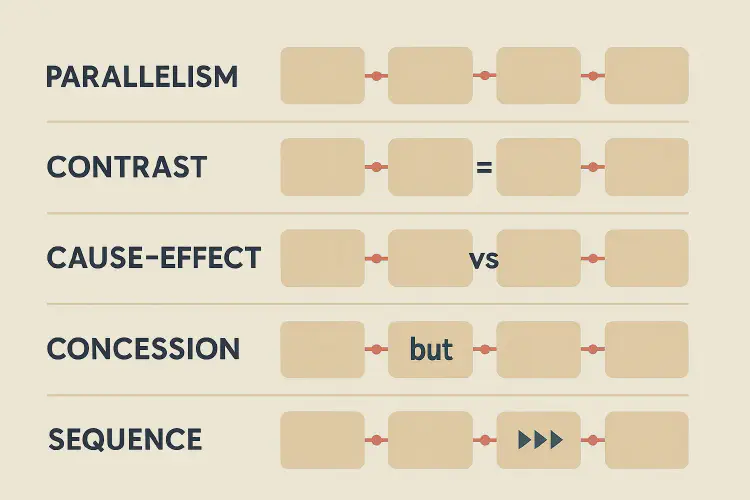
Compound sentences connect two or more clauses. Chengyu (成语) can appear in each clause to create rhythm and logic—**parallelism, contrast, cause–effect, concession, sequence**. Use the idiom (with pinyin) in Chinese; keep all explanations in English.
- Chengyu Idioms
- 3 min read
Parallelism (balanced, matched rhythm)
Use two chengyu in mirrored clauses for cadence and emphasis.
- Pattern: Clause A(chengyu),Clause B(chengyu)。
Example: 循序渐进 (xún xù jiàn jìn) 打基础,精益求精 (jīng yì qiú jīng) 提品质。
Meaning: “Build step by step, then refine for quality.” - Tip: Keep semantics complementary (method → outcome, mindset → action); limit to two idioms.
Contrast (A vs. B)
Signal difference with linkers like 而/却/但.
- Pattern: Clause A(chengyu),而 Clause B(chengyu)。
Example: 居安思危 (jū ān sī wēi) 做预案,而不是 得过且过 (dé guò qiě guò) 等问题出现。
Meaning: “Prepare while calm, instead of muddling through.” - Soft contrast: 用 不过/然而 to reduce harshness.
Cause → Effect (because/therefore)
Combine a “principle” chengyu with a “result” chengyu.
- Pattern: 由于 Clause A(chengyu),因此/所以 Clause B(chengyu/result)。
Example: 由于我们未雨绸缪 (wèi yǔ chóu móu),所以上线水到渠成 (shuǐ dào qú chéng)。
Meaning: “Because we prepared early, the launch happened naturally.” - Swap order: 先果后因 with 因此/因为 as needed.
Concession (although… still…)
Admit a challenge, maintain stance.
- Pattern: 虽然 Clause A(problem),但是 Clause B(chengyu)。
Example: 虽然人手紧张,但是推进仍然有条不紊 (yǒu tiáo bù wěn)。
Meaning: “Despite shortages, progress stayed orderly.” - Variant: 尽管…仍然… for formal tone.
Sequence & Progression (first… then…)
Map phases with action-like idioms.
- Pattern: 先 Clause A(chengyu),再/然后 Clause B(chengyu/verb)。
Example: 先抽丝剥茧 (chōu sī bō jiǎn) 查因,再稳扎稳打 (wěn zhā wěn dǎ) 推进修复。
Meaning: “Diagnose carefully first, then advance steadily.”
Conditionals (if… then…)
Tie the choice to an outcome.
- Pattern: 如果 Clause A(chengyu/condition),就 Clause B(chengyu/verb)。
Example: 如果培训循序渐进 (xún xù jiàn jìn),就更易达到事半功倍 (shì bàn gōng bèi) 的效果。
Meaning: “If training proceeds step by step, you get double the effect.”
Purpose & Means (in order to… by…)
Pair a goal with a method idiom.
- Pattern: 为了 目的,我们 [chengyu] + Verb,以便 结果。
Example: 为了稳定供给,我们统筹兼顾 (tǒng chóu jiān gù) 各环节,以便交付名副其实 (míng fù qí shí)。
Meaning: “To stabilize supply, we balance all parts so delivery truly matches its name.”
Apposition & Explanation (dash/colon style)
Place a chengyu then explain, or vice versa.
- Pattern: Clause A——chengyu:explanation.
Example: 复盘目标——温故知新 (wēn gù zhī xīn):通过旧案生出新法。 - Works well in slides, memos, abstracts.
Multi-Clause Do’s & Don’ts
- One idiom per clause is usually enough; let facts carry detail.
- Keep logical linkers explicit (而、因此、虽然、如果、为了).
- Avoid mixing registers (very literary + slang) in the same sentence.
- Maintain parallel structure (same part of speech around the comma).
Ready-to-Copy Frames (swap in your idioms)
- Parallel: A(chengyu) 做准备,B(chengyu) 取成果。
- Contrast: A(chengyu) 面对风险,而 B(chengyu) 只会拖延。
- Cause–effect: 因为 A(chengyu),所以 结果 B(chengyu/verb)。
- Concession: 虽然 条件不足,但是 流程 A(chengyu)。
- Sequence: 先 A(chengyu),再 B(chengyu/verb)。
- Conditional: 如果 A(chengyu),就 结果 B(chengyu)。
Mini Dialogues (natural and concise)
- A: “How did you ship on time?”
B: “因为 未雨绸缪,所以 水到渠成。” - A: “Why not launch everything now?”
B: “虽然 需求很多,但是 我们要 稳扎稳打。”
Quick Practice (pick the best connector + idioms)
- You want balanced prep → outcome: 因为 未雨绸缪,所以 水到渠成。
- Show disciplined method vs. sloppy approach: 居安思危,而非 得过且过。
- First diagnose, then execute: 先 抽丝剥茧,再 稳扎稳打。
- Despite pressure, keep order: 虽然 紧迫,但是 有条不紊。
- If stepwise training, then efficient results: 如果 循序渐进,就 事半功倍。
Common Pitfalls (and fixes)
- Overstuffing clauses: If both clauses already contain data, consider keeping a chengyu in only one clause.
- Mismatched parts of speech: Pair stative with stative (predicates) or action with action (adverbials) across commas.
- Vague logic: Always add a visible linker (而/所以/虽然/如果/为了) to show the relationship clearly.
Takeaway: In compound sentences, let chengyu anchor each clause’s role—parallel for rhythm, contrast for stance, 因果/让步/条件/顺承 for logic. Keep one idiom per clause, choose explicit linkers, and match the idiom’s semantics to the clause function for clean, persuasive sentences.