Placement in sentences
Where you place a chengyu changes **tone**, **clarity**, and **rhythm**. Use Chinese for the idiom + pinyin; keep all explanations and scaffolding in English.
- Chengyu Idioms
- 3 min read
Article 2 of 5 in Chengyu-and-Grammar/
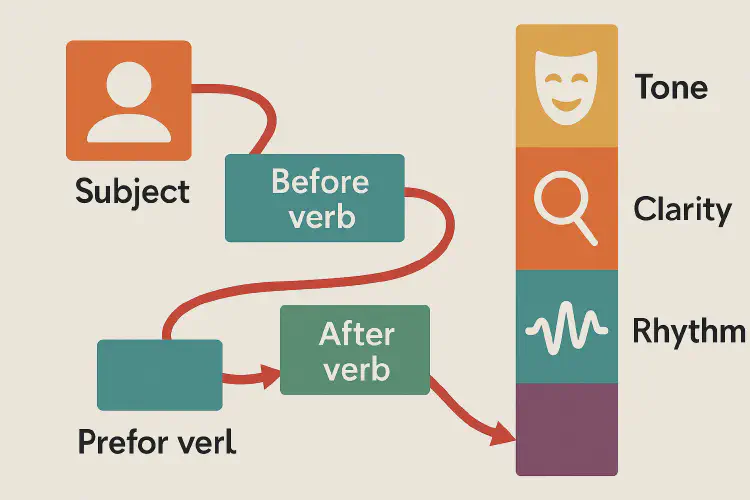
Sentence-Initial: Framing, Headline Tone
Use at the start to set the theme or stance (formal/concise).
- Pattern: Chengyu,+ comment/claim
Example: 未雨绸缪 (wèi yǔ chóu móu),我们本周完成备份计划。
Meaning: “Prepared in advance, we’ll finish the backup plan this week.” - Pattern: Chengyu:+ action/definition (colon, slide/heading style)
Example: 实事求是 (shí shì qiú shì):结论以数据为准。 - Use when you need framing (policy, memos, topic sentences).
Sentence-Medial: Smooth, Neutral Information Flow
Place after the subject or before the main verb to describe manner or state.
- Pattern: Subject + 很/相当 + [stative chengyu]
Example: 流程很有条不紊 (yǒu tiáo bù wěn)。 - Pattern: Subject + [chengyu(+地)] + Verb (adverbial manner)
Example: 团队稳扎稳打 (wěn zhā wěn dǎ) 推进。 - This is the most common placement in everyday writing and speech.
Sentence-Final: Punchline, Emphasis, Closure
End with a chengyu to deliver the key evaluation/moral.
- Pattern: …,chengyu。
Example: 方案简洁、易学,用户反馈一清二楚 (yì qīng èr chǔ)。 - Pattern: …,可谓 + chengyu。 (metacomment)
Example: 版本上线顺利,可谓 水到渠成 (shuǐ dào qú chéng)。 - Good for conclusion sentences and reviews.
Negation & Degree: Fine-Tuning Meaning
- Degree adverbs (soften/strengthen): 很/相当/极其 + 有条不紊、清晰、稳妥
Example: 排练相当有条不紊。 - Negation: 不/并不 + chengyu
Example: 成功并非水到渠成 (shuǐ dào qú chéng),背后是大量准备。 - Tip: Many chengyu are stative; degree/negation sits before them.
With 的 / 地 / 得: Modifier vs. Manner vs. Complement
- 的 (de) → modifies a noun
Example: 一丝不苟的 (yì sī bù gǒu de) 检查。 - 地 (de) → modifies a verb (manner)
Example: 泰然自若地 (tài rán zì ruò de) 回答。 - 得 (de) → follows a verb to evaluate degree
Example: 演奏得行云流水 (xíng yún liú shuǐ)。
Parallelism & Contrast: Rhythmic Placement
Balance two clauses with matched positions for cadence.
- Pattern: [Clause A with chengyu],[Clause B with chengyu]
Example: 循序渐进 (xún xù jiàn jìn) 打基础,精益求精 (jīng yì qiú jīng) 提品质。 - Contrast pattern: A(chengyu),而 B(chengyu)
Example: 居安思危,而非得过且过 (dé guò qiě guò)。
Questions, Commands, and Softeners
- Yes–no question: 押后成语或加语气词
Example: 计划一清二楚了吗? - Command/advice: 切题、简短,成语放前或后都行
Example: 三思而行 (sān sī ér xíng),再提交。 / 提交前三思而行。 - Softeners (polite critique): 似乎/可能/有点 + chengyu
Example: 这个排版有点 画蛇添足 (huà shé tiān zú)。
Placement by Idiom Type (quick chooser)
- Stative quality (clarity/order/calm): best predicate/medial/final
Examples: 一清二楚、有条不紊、泰然自若。 - Action-like (method/procedure): best adverbial/medial
Examples: 稳扎稳打、再接再厉、同舟共济。 - Aphoristic (principle/moral): best initial/heading/subject
Examples: 欲速则不达、水到渠成、实事求是。
Mini Templates (copy, then swap the idiom)
- Initial (framing): [chengyu],+ action. → 未雨绸缪,下周演练。
- Medial (manner/state): Subject + [chengyu] + Verb/Be. → 团队稳扎稳打推进。
- Final (punch): …,[chengyu]。 → 数据与口碑一致,名副其实 (míng fù qí shí)。
- Modifier: [chengyu + 的] + noun → 去繁就简的 (qù fán jiù jiǎn de) 设计。
Quick Practice (choose best placement)
- You want to frame the principle at the start → sentence-initial 实事求是。
- You need a manner before the main verb → medial 稳扎稳打。
- You want a concluding punch → sentence-final 水到渠成。
- You modify a noun → 一丝不苟的 检查。
- You soften criticism in chat → “这版有点 画蛇添足。”
Common Pitfalls (and fixes)
- Stacking: avoid multiple idioms in one clause; pick one and add facts.
- Misplaced 的/地/得: match noun vs. verb vs. degree.
- Verb-forcing: many chengyu aren’t verbs; add a main verb (推进/完成/优化).
- Over-formality in casual chat: swap lofty idioms for simpler ones (一清二楚、得心应手).
Takeaway: Think initial = frame, medial = manner/state, final = emphasis. Add 的/地/得 correctly, keep one idiom per clause, and align the idiom’s semantics with the slot for clear, natural sentences.