Historical anecdotes behind chengyu
Many **chengyu (成语)** come straight from crisp historical moments—duels of wits at court, do-or-die battlefield gambits, and public acts of apology or resolve. Retelling the micro-story fixes the idiom’s meaning and helps you use it naturally.
- Chengyu Idioms
- 3 min read
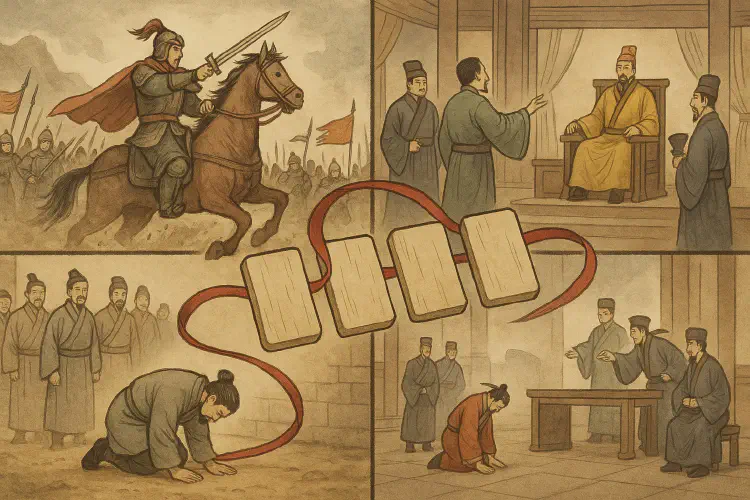
Court & Diplomacy: Quick-Wittedness, Pride, and Testing Loyalty
完璧归赵 (wán bì guī Zhào) — “return the jade intact to Zhao”
Story: Envoy Lín Xiàngrú safeguarded the precious Heshibi jade from a greedy Qin king and brought it back unharmed to Zhao through nerve and tact.
Moral/Use: Protect interests with courage and strategy.
Example: 面对不平等条款,他据理力争,终使项目完璧归赵。
指鹿为马 (zhǐ lù wéi mǎ) — “call a deer a horse”
Story: Courtier Zhao Gao presented a deer and insisted it was a horse to test who dared oppose him; many officials, fearing reprisal, agreed.
Moral/Use: Deliberate distortion of truth to bully others.
Example: 篡改数据还强词夺理,简直指鹿为马。
负荆请罪 (fù jīng qǐng zuì) — “carry brambles to seek punishment”
Story: General Lián Pō wronged Lín Xiàngrú; realizing his fault, he carried thorny brambles to Lin’s door to apologize sincerely.
Moral/Use: Admit mistakes humbly.
Example: 我误会了你,愿负荆请罪。
Battlefield Tactics: No-Return Resolve & Strategic Indirection
破釜沉舟 (pò fǔ chén zhōu) — “break cauldrons, sink boats”
Story: Xiang Yu destroyed his own cooking pots and boats before battle, eliminating retreat to boost morale and win.
Moral/Use: Commit fully at critical junctures.
Example: 到了生死关头,只能破釜沉舟。
背水一战 (bèi shuǐ yī zhàn) — “fight with back to the river”
Story: Han Xin arrayed troops with a river at their backs; no escape forced a ferocious, victorious stand.
Moral/Use: Turn pressure into decisive courage.
Example: 期限将至,我们必须背水一战。
围魏救赵 (wéi Wèi jiù Zhào) — “besiege Wei to save Zhao”
Story: Strategist Sun Bin struck Wei’s home base to relieve pressure on Zhao rather than attacking the frontline.
Moral/Use: Solve a problem indirectly by hitting its source.
Example: 先改善供应链,算是围魏救赵。
Fear, Misjudgment, and Aftershock
纸上谈兵 (zhǐ shàng tán bīng) — “discuss warfare on paper”
Story: Commander Zhao Kuo mastered theory but failed in real combat, leading to disaster.
Moral/Use: Book smarts without practice lead to failure.
Example: 方案别纸上谈兵,先做小试点。
草木皆兵 (cǎo mù jiē bīng) — “every bush and tree looks like soldiers”
Story: After defeat, jittery troops mistook shadows and foliage for enemies.
Moral/Use: Paranoia under stress; overreaction.
Example: 别因一次失利就草木皆兵。
四面楚歌 (sì miàn Chǔ gē) — “Chu songs on all sides”
Story: Xiang Yu was besieged while hearing his homeland’s songs, realizing isolation and collapse.
Moral/Use: Surrounded and abandoned.
Example: 舆论风向逆转,他感到四面楚歌。
Endurance & Long-Game Strategy
卧薪尝胆 (wò xīn cháng dǎn) — “sleep on brushwood, taste gall”
Story: Goujian endured humiliation for years, self-disciplining until he could reclaim his state.
Moral/Use: Bear hardship to stage a comeback.
Example: 创业早期要卧薪尝胆。
韬光养晦 (tāo guāng yǎng huì) — “sheathe brightness, nurture obscurity”
Story: Statesmen hid talent and bided time amid turbulent politics.
Moral/Use: Keep a low profile; prepare quietly.
Example: 先韬光养晦,成熟再发力。
How to Retell Any Chengyu Anecdote (3 Moves)
- 场景:谁/何时/在哪里(朝廷、军营、边城)。
- 动作:关键举措或转折(毁船断后、曲线救国、负荆请罪)。
- 原则/用途:一句话抽出可复用的行为准则,并附一条现代例句。
Mini Practice — Match Scene to Idiom
- (认错负责,姿态诚恳) → 负荆请罪
- (直面绝境反而激发斗志) → 背水一战
- (总部受攻,前线获解) → 围魏救赵
- (纸上功夫好,实战糟糕) → 纸上谈兵
- (孤立无援的处境) → 四面楚歌
Tips for Learners
- 把每条压缩成 15秒故事:人名 + 一招 + 结果 + 成语。
- 在写作/演讲中用 “小故事→成语→现代例句” 的结构,既有文化感又清晰有力。
- 避免连珠炮式堆叠;一段一条即可突出重点。
Takeaway: 历史瞬间被浓缩为四字密码。掌握其人其事与一条现代用法,你就能把 成语=故事+原则 这一点真正用活。