Moral lessons within chengyu
Many **chengyu (成语)** encode compact **moral lessons**. Knowing the virtue/vise behind each idiom helps you choose expressions that guide behavior, persuade readers, and structure stories.
- Chengyu Idioms
- 3 min read
Article 3 of 5 in Chengyu-and-Storytelling/
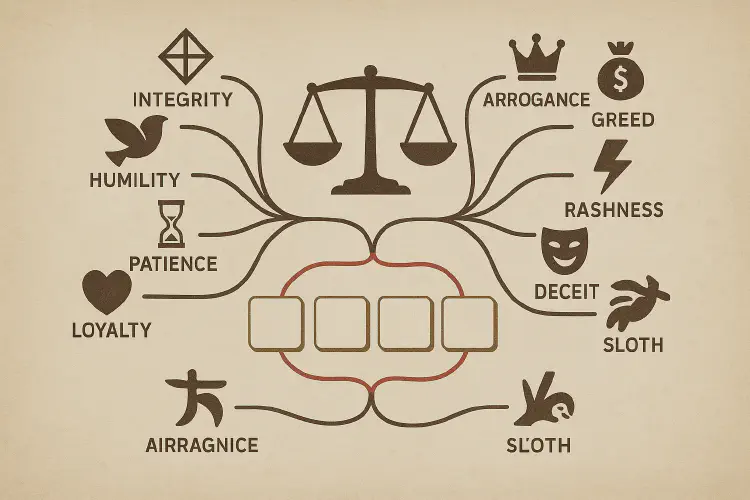
Virtues Highlighted by Chengyu (Praise & Guidance)
- Diligence & Steadiness
循序渐进 (xún xù jiàn jìn) — progress step by step → Plan, then proceed steadily.
稳扎稳打 (wěn zhā wěn dǎ) — advance solidly → Win by consistency, not flash.
持之以恒 (chí zhī yǐ héng) — persevere unremittingly → Keep going to cross the finish line. - Foresight & Preparation
未雨绸缪 (wèi yǔ chóu móu) — repair the roof before it rains → Prepare early to avoid loss.
胸有成竹 (xiōng yǒu chéng zhú) — plan fully in mind → Think through, then act calmly. - Learning & Reflection
温故知新 (wēn gù zhī xīn) — review the old to know the new → Reflect to innovate.
举一反三 (jǔ yī fǎn sān) — infer more from one → Generalize wisely from examples. - Integrity & Humility
言行一致 (yán xíng yī zhì) — words match deeds → Walk the talk.
虚怀若谷 (xū huái ruò gǔ) — humble as a valley → Stay open and modest. - Courage & Resolve
破釜沉舟 (pò fǔ chén zhōu) — break kettles and sink boats → Commit fully when the time comes.
背水一战 (bèi shuǐ yī zhàn) — fight with back to the river → Find strength in decisive moments.
Vices Warned Against (Cautionary Lessons)
- Overdoing & Excess
画蛇添足 (huà shé tiān zú) — add feet to a snake → Too much ruins enough. - Complacency & Passivity
守株待兔 (shǒu zhū dài tù) — wait by a stump for rabbits → Don’t rely on luck. - Self-Deception & Panic
掩耳盗铃 (yǎn ěr dào líng) — cover ears to steal a bell → Fooling yourself fools no one.
杯弓蛇影 (bēi gōng shé yǐng) — fear a bow’s shadow as a snake → Check facts before fearing. - Arrogance & Borrowed Power
狐假虎威 (hú jiǎ hǔ wēi) — bully by borrowed might → Authority ≠ righteousness.
眼高手低 (yǎn gāo shǒu dī) — high aims, low skills → Match ambition with practice. - Rigidity & Misfit Methods
刻舟求剑 (kè zhōu qiú jiàn) — carve the boat to seek the sword → Adapt methods to change.
Paired Morals (Use as Story Axes)
- Preparation vs. Impulse: 未雨绸缪 ↔ 欲速则不达 (more haste, less speed).
- Humility vs. Pretension: 虚怀若谷 ↔ 叶公好龙 (claims love, fears the real thing).
- Steadiness vs. Showiness: 稳扎稳打 ↔ 画蛇添足。
- Adaptation vs. Stubbornness: 因地制宜 (adapt to local conditions) ↔ 刻舟求剑。
How to Extract the Moral Quickly (3-Step Lens)
- Image:记住画面(蛇加足、舟刻记、背水阵)。
- Cause→Effect:是谁、做了什么、结果如何。
- Principle:把经验抽象成一句可复用的行为准则(如“先准备,后行动”)。
Moral Genres You Can Signal with One Chengyu
- Prudence:三思而行、未雨绸缪
- Resilience:卧薪尝胆、卷土重来
- Teamwork:同舟共济、各司其职
- Clarity/Truth:一清二楚、实事求是
- Ethics/Rectitude:名正言顺、恪尽职守
Plug-and-Play Sentences (Persuasive Tone)
- 方案上线前要未雨绸缪,否则容易画蛇添足。
- 面对变化,别刻舟求剑;因地制宜才高效。
- 成功并非偶然,循序渐进才能水到渠成。
Micro-Practice(Choose the Best Moral Tool)
- 想一步登天,结果返工连连 → 欲速则不达
- 立项前做好备选方案 → 未雨绸缪
- 夸口靠关系吓唬人 → 狐假虎威
- 反思旧案得到新思路 → 温故知新
- 目标很高但缺训练 → 眼高手低
Common Pitfalls (Avoid Moral Misfires)
- 只看字面:成语讲的是原则,不是表面动作。
- 堆砌成语:一条核心道理即可;多了反弱化。
- 场合不匹配:批评用语(如 狐假虎威)在正式场合要委婉。
Takeaway: 把成语当作道德与行为的快捷键:用一条四字语点明“应做/不应做”,你的叙事与劝说都会更有力、更难忘。