Chengyu for problem-solving
Use these chengyu to structure **diagnosis → planning → execution → review**. Chengyu and pinyin appear in Chinese; all explanations and examples are in English. Pick one per step, add a plain-English sentence or metric, and your plan will read crisp and native-like.
- Chengyu Idioms
- 4 min read
Article 4 of 5 in Chengyu-by-Function/
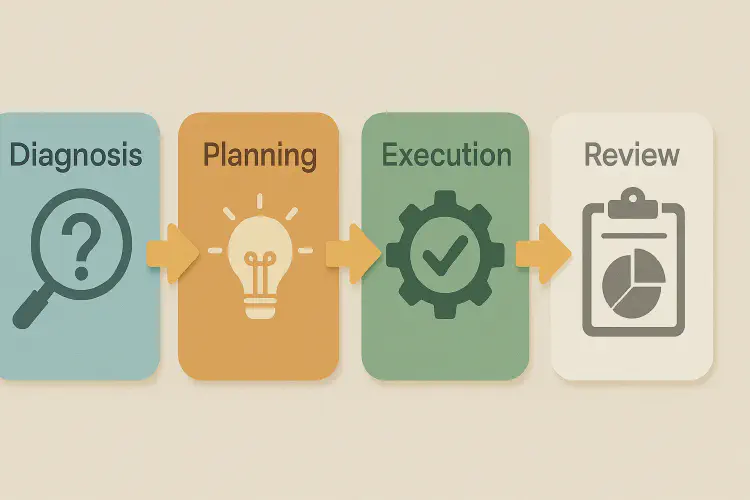
Diagnose the Problem (clarify facts, avoid noise)
- 抽丝剥茧 (chōu sī bō jiǎn) — “tease out the silk; peel the cocoon” → systematically unravel complexity. Use: “Let’s 抽丝剥茧 through logs before proposing fixes.”
- 一针见血 (yì zhēn jiàn xiě) — pinpoint the core issue. Use: “Your question 一针见血—the bottleneck is I/O.”
- 去伪存真 (qù wěi cún zhēn) — discard false leads, keep truth. Use: “De-dup rumors; 去伪存真 with verified data.”
Plan & Prepare (set methods, sequence, safeguards)
- 未雨绸缪 (wèi yǔ chóu móu) — prepare before it rains. Use: “Add backups now—未雨绸缪 beats crisis mode.”
- 因地制宜 (yīn dì zhì yí) — adapt to local conditions. Use: “For rural users we’ll 因地制宜: SMS first, app later.”
- 统筹兼顾 (tǒng chóu jiān gù) — balance multiple goals. Use: “统筹兼顾 cost, UX, and reliability in the roadmap.”
Execute Step by Step (avoid overreach, show progress)
- 循序渐进 (xún xù jiàn jìn) — proceed in ordered steps. Use: “Roll out in three waves—循序渐进.”
- 稳扎稳打 (wěn zhā wěn dǎ) — steady, solid advance. Use: “QA first, then deploy—稳扎稳打.”
- 事半功倍 (shì bàn gōng bèi) — half the effort, double the result. Use: “Automate checks for 事半功倍 gains.”
Iterate & Improve (learn fast, trim excess)
- 举一反三 (jǔ yī fǎn sān) — infer more from one case. Use: “Fix this class of bugs via 举一反三 patterns.”
- 精益求精 (jīng yì qiú jīng) — pursue excellence further. Use: “After MVP, 精益求精 the onboarding flow.”
- 去繁就简 (qù fán jiù jiǎn) — remove clutter, keep essentials. Use: “UI refactor: 去繁就简 to raise conversion.”
Teamwork & Coordination (divide work, push together)
- 分工合作 (fēn gōng hé zuò) — division of labor and cooperation. Use: “Docs, data, deploy—分工合作 for speed.”
- 各司其职 (gè sī qí zhí) — each fulfills their role. Use: “With 各司其职, incidents clear faster.”
- 同舟共济 (tóng zhōu gòng jì) — pull together to overcome. Use: “Ops and support 同舟共济 during outages.”
Risk Control & Decision (choose, hedge, act)
- 三思而行 (sān sī ér xíng) — think thrice, then act. Use: “Security change? 三思而行 + peer review.”
- 权衡利弊 (quán héng lì bì) — weigh pros and cons. Use: “We’ll 权衡利弊: latency vs. cost.”
- 当机立断 (dāng jī lì duàn) — decide promptly when timing matters. Use: “Traffic spiking—当机立断 add capacity.”
Conflict & Constraint Handling (unlock blockers)
- 化繁为简 (huà fán wéi jiǎn) — turn complexity into simplicity. Use: “Merge forms—化繁为简 reduces drop-offs.”
- 变通权宜 (biàn tōng quán yí) — flexible, expedient workaround. Use: “Holiday rush? 变通权宜 with a manual queue.”
- 各取所长 (gè qǔ suǒ cháng) — use each party’s strengths. Use: “Agency designs, in-house integrates—各取所长.”
Root-Cause & Prevention (close the loop)
- 追本溯源 (zhuī běn sù yuán) — trace to the origin. Use: “Postmortem must 追本溯源 beyond symptoms.”
- 防微杜渐 (fáng wēi dù jiàn) — stop small issues early. Use: “Lint + alerts = 防微杜渐 for regressions.”
- 长治久安 (cháng zhì jiǔ ān) — long-term stability. Use: “Refactor for 长治久安 rather than hotfixes.”
Placement Patterns (plug and play)
- Chengyu + noun: “a 去繁就简 layout,” “循序渐进 rollout.”
- Predicate use: “This plan is 统筹兼顾.”
- Clause pivot: “权衡利弊后,我们选择方案B.”
Mini Templates (copy, then personalize)
- Diagnosis ticket: “Logs first—抽丝剥茧; remove rumors—去伪存真; summary at 17:00.”
- Rollout plan: “Pilot → region → nationwide (循序渐进, 稳扎稳打). Rollback path ready (未雨绸缪).”
- Decision note: “We 权衡利弊; latency wins. 当机立断 to scale nodes by 30%.”
Quick Practice (choose the best chengyu)
- Simplify forms to raise completion → 去繁就简 / 化繁为简.
- Prepare backups before peak season → 未雨绸缪.
- Balance user needs and cost → 统筹兼顾.
- Trace the real source of failures → 追本溯源.
- Deploy in phases, not all at once → 循序渐进 / 稳扎稳打.
Common Pitfalls (and fixes)
- Using a criticism chengyu instead of a solution one: swap 纸上谈兵 (critique) for 循序渐进 (plan) + an action.
- Stacking too many idioms: one per step keeps it clean.
- Vague without actions: follow each chengyu with a metric, owner, or deadline.
Takeaway: Build a problem-solving line with four moves—抽丝剥茧 (diagnose) → 统筹兼顾 (plan) → 循序渐进/稳扎稳打 (execute) → 追本溯源/防微杜渐 (learn & prevent). One precise chengyu + one concrete action = clear, persuasive problem-solving.