Chengyu to criticize
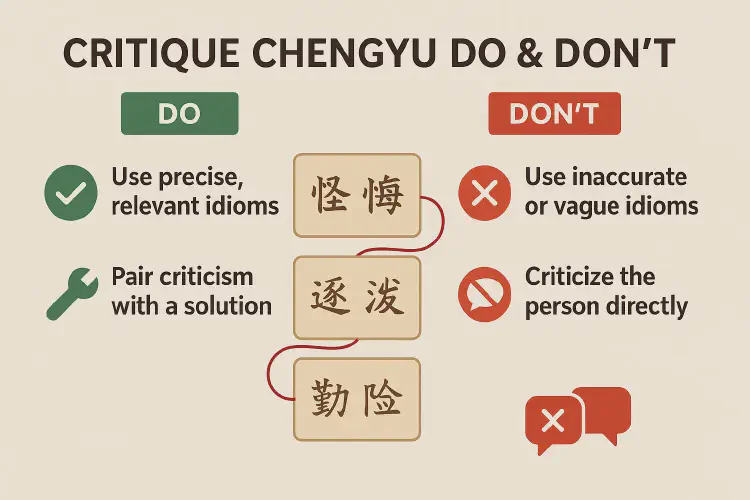
Use these four-character expressions to deliver precise, culturally natural criticism. Keep the chengyu in Chinese with pinyin; give explanations and examples in English. Aim at the issue, not the person, and pair criticism with a fix.
- Chengyu Idioms
- 3 min read
Article 2 of 5 in Chengyu-by-Function/
Overdoing, Overcomplicating, or Misfitting the Method
- 画蛇添足 (huà shé tiān zú) — “to add feet to a snake” → overdo and ruin a good thing.
Use: “The redesign feels 画蛇添足—let’s remove the extra animations.” - 刻舟求剑 (kè zhōu qiú jiàn) — stick with a method despite changing conditions.
Use: “Copying last year’s plan is 刻舟求剑 given the new market.” - 好大喜功 (hào dà xǐ gōng) — chase flashy achievements, ignore substance.
Use: “Giant PR stunts without service fixes look 好大喜功.”
Empty Talk, Wishful Thinking, or Poor Execution
- 纸上谈兵 (zhǐ shàng tán bīng) — armchair strategizing; theory divorced from practice.
Use: “Let’s avoid 纸上谈兵—ship a small prototype first.” - 一厢情愿 (yì xiāng qíng yuàn) — wishful thinking; assume others will agree.
Use: “Forecasting 100% adoption is 一厢情愿.” - 得过且过 (dé guò qiě guò) — muddle through; do the bare minimum.
Use: “Quarterly reviews felt 得过且过—we need action items.” - 敷衍塞责 (fū yǎn sè zé) — perfunctory, just to tick a box.
Use: “This report reads 敷衍塞责; please add the dataset and methods.”
Skill Gaps, Laziness, or Messiness
- 眼高手低 (yǎn gāo shǒu dī) — high aims, low skills; ambition without practice.
Use: “The concept is bold, but execution is 眼高手低.” - 拖泥带水 (tuō ní dài shuǐ) — sloppy and inefficient; not crisp.
Use: “The handover was 拖泥带水; let’s create a checklist.” - 乱七八糟 (luàn qī bā zāo) — a mess; disorganized.
Use: “File names are 乱七八糟—standardize before release.”
Dishonesty, Inconsistency, or Manipulation
- 自相矛盾 (zì xiāng máo dùn) — self-contradictory.
Use: “The memo is 自相矛盾 about budget and scope.” - 指鹿为马 (zhǐ lù wéi mǎ) — call a deer a horse; brazen distortion of fact.
Use: “Labeling these losses as ‘growth’ is 指鹿为马.” - 狐假虎威 (hú jiǎ hǔ wēi) — bully by borrowed power.
Use: “Invoking ‘head office said so’ feels 狐假虎威.” - 掩耳盗铃 (yǎn ěr dào líng) — self-deception; cover your ears to steal a bell.
Use: “Ignoring the error logs is 掩耳盗铃.”
Fickleness, Panic, or Overreaction
- 朝三暮四 (zhāo sān mù sì) — change tune for show; fickle reframing.
Use: “Policy shifts every week look 朝三暮四.” - 杯弓蛇影 (bēi gōng shé yǐng) — see a snake in a cup’s bow-shadow; groundless fear.
Use: “Worrying about rumors is 杯弓蛇影—check the source.”
Tone & Register: Make Criticism Productive
- Prefer issue-focused lines: “The plan is 纸上谈兵” (not “You are…”).
- Offer a repair clause after the idiom: “This feels 画蛇添足—let’s revert to the minimal layout.”
- Avoid stacking: one chengyu per paragraph/message is enough.
- For public settings, soften with hedges: “seems/risks/leans toward + chengyu.”
Useful Patterns (drop-in templates)
- “Current scope 一厢情愿; propose a user test with 15 participants.”
- “Timeline is 拖泥带水; recommend weekly milestones.”
- “Metrics labeling borders on 指鹿为马; please align with GAAP terms.”
Quick Practice (choose the best chengyu)
- Slides keep adding effects until usability drops → 画蛇添足.
- Fancy theory, no pilot or data → 纸上谈兵.
- Ambition high, hands-on skill weak → 眼高手低.
- Call losses ‘wins’ in the report → 指鹿为马.
- Change the story every day to appease critics → 朝三暮四.
Common Pitfalls (and fixes)
- Mistaking any four characters for chengyu → verify before using.
- Over-harsh tone → pair the chengyu with a next step (“test, trim, clarify”).
- Cultural mismatch → pick high-frequency items (纸上谈兵、画蛇添足、自相矛盾) that readers are likely to know.
Takeaway: Choose one precise chengyu to label the problem—纸上谈兵、画蛇添足、眼高手低、自相矛盾、指鹿为马、敷衍塞责—and immediately follow with a concrete fix. That’s clear, firm, and respectful.