Difference between chengyu, proverbs, and idioms
Learners often lump **chengyu**, **proverbs**, and **idioms** together, but they differ in **form**, **origin**, **flexibility**, and **usage**. This guide gives you quick tests and examples so you can choose the right tool for the right context.
- Chengyu Idioms
- 3 min read
Article 5 of 5 in Introduction-to-Chengyu/
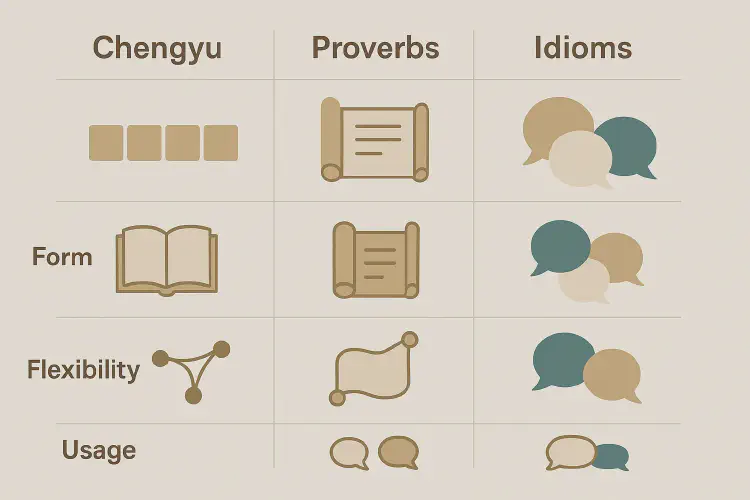
Overview: Three Related but Distinct Categories
In Chinese, fixed expressions come in many types. The three you will meet most often are chengyu (成语), proverbs (谚语 yànyǔ), and idioms (习语 xíyǔ). Some overlap exists, but each category has typical features.
What Is a Chengyu (成语)?
- Form: Usually four characters; highly fixed (characters and order rarely change).
- Origin: Often traceable to classical texts, history, or literary anecdotes.
- Grammar & register: Concise, elliptical, with a literary flavor; works as predicate, modifier, adverb, or (less often) subject/object.
- Function: Compress a story or moral into a compact allusion.
- Examples: 画蛇添足 (to ruin by overdoing), 自相矛盾 (self-contradictory), 亡羊补牢 (better late than never).
What Is a Proverb (谚语)?
- Form: A full sentence or couplet; length varies (not restricted to four characters).
- Origin: Folk wisdom and everyday life; less tied to classical literature.
- Grammar & register: Complete syntax with subject/verb; colloquial, didactic, often rhythmic or rhymed.
- Function: Give general advice or observation; easy to quote as is.
- Examples:
- 早起的鸟儿有虫吃 — The early bird gets the worm.
- 不打不成器 — Without tempering, one won’t become useful.
What Is an Idiom (习语)?
- Form: Any fixed or semi-fixed expression whose meaning isn’t strictly literal; length is flexible.
- Origin: Broad—could be modern slang, set phrases, or loan translations; not necessarily classical.
- Grammar & register: Ranges from informal to neutral; includes collocations and fixed patterns used in daily speech.
- Function: Natural-sounding, conventional ways to say things; may or may not be moralizing or literary.
- Examples:
- 没门儿 (no way; very colloquial).
- 一举两得 (kill two birds with one stone; note: this one is four-character and overlaps with chengyu lists in many textbooks).
Side-by-Side Comparison (Quick Reference)
- Formality: chengyu (more literary) > idioms (mixed) ≈ proverbs (neutral/common).
- Fixity: chengyu (very fixed) > proverbs (fixed sentence) > idioms (varies).
- Length: chengyu (mostly 4 chars) vs. proverbs (sentence-length) vs. idioms (any length).
- Source: chengyu (classical), proverbs (folk), idioms (broad/modern or traditional).
- Function: chengyu (allusion/conciseness), proverbs (advice/truth), idioms (natural phrasing/figurative speech).
Overlap and Border Cases
- Some four-character expressions appear in both chengyu lists and as everyday idioms; classification can be usage-based.
- Not every four-character phrase online is a traditional chengyu; many are modern slogans or memes.
- A proverb can be condensed into a chengyu over time, or a chengyu can be paraphrased into a proverb-like sentence for clarity.
Practical Tests You Can Apply
- Four-character + classical aura? Likely chengyu.
- Reads like a full sentence giving advice? Likely a proverb.
- Fixed but flexible length, sounds natural in daily talk, figurative? Likely an idiom.
- Can I change words or order? If no, chengyu or proverb; if somewhat, idiom.
- Needs background story to grasp fully? Often chengyu.
Usage Guidance for Learners
- Clarity first: In beginner conversations, proverbs and plain idioms may be clearer than rare chengyu.
- Register-awareness: Use chengyu to elevate style in writing, presentations, or formal talk.
- Learn with stories: For chengyu, pair the origin story + idiomatic sense + sample sentence to cement memory.
- Avoid overuse: Too many chengyu can feel ornate; sprinkle for emphasis.
Mini Practice
- Classify each:
- 守株待兔 — classical allusion, 4-char → chengyu.
- 饭来张口,衣来伸手 — sentence-like proverb about laziness → proverb.
- 一点也不 — fixed colloquial pattern → idiom/set phrase.
Takeaway: Think form (4-char vs sentence), origin (classical vs folk vs modern), and flexibility. Chengyu are compact, classical allusions; proverbs are folk sentences carrying advice; idioms are the wider family of conventional, sometimes figurative expressions you’ll hear every day.