Historical origins of chengyu
To understand **chengyu (成语)**, it helps to know where they come from. Most crystallized out of classical texts, historical anecdotes, and literary works, then spread through education and everyday usage over centuries.
- Chengyu Idioms
- 3 min read
Article 2 of 5 in Introduction-to-Chengyu/
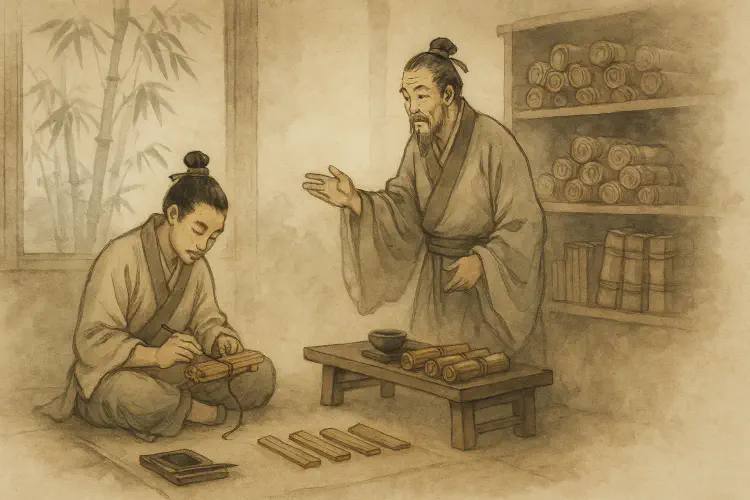
Where Chengyu Come From: A Historical Overview
Chengyu are rooted in pre-modern Chinese culture. Many began as memorable lines, images, or morals in classical works and historical records, later condensed into four characters.
Pre-Qin and Warring States Foundations
- Philosophical texts: Works like Lunyu (Analects), Mengzi, Zhuangzi, Han Feizi, and Lüshi Chunqiu supplied vivid parables and aphorisms that later fossilized as chengyu.
- Example: 井底之蛙 (jǐng dǐ zhī wā, “frog at the bottom of a well”) — a Zhuangzi image about narrow perspective.
- Example: 刻舟求剑 (kè zhōu qiú jiàn, “carve the boat to seek the sword”) — a caution against rigid thinking often traced to Warring States thought.
- Diplomatic anecdotes: Zhànguó Cè (Strategies of the Warring States) preserves political fables that became idioms.
- Example: 狐假虎威 (hú jiǎ hǔ wēi, “the fox borrows the tiger’s might”) — abusing power by leaning on a stronger backer.
Qin–Han: History as a Source
- Grand histories: Shǐjì (Records of the Grand Historian) and Hànshū (Book of Han) narrated dramatic campaigns and court intrigues that distilled into chengyu.
- Examples: 破釜沉舟 (pò fǔ chén zhōu, “break the cauldrons and sink the boats”) — fight with do-or-die resolve;
背水一战 (bèi shuǐ yī zhàn, “battle with your back to the river”) — a desperate but decisive stand;
指鹿为马 (zhǐ lù wéi mǎ, “call a deer a horse”) — brazenly twisting facts.
- Examples: 破釜沉舟 (pò fǔ chén zhōu, “break the cauldrons and sink the boats”) — fight with do-or-die resolve;
Six Dynasties to Tang–Song: Literature Shapes Expression
- Anecdote collections and zhìguài/shi-shuo genres circulated compact moral tales that fed idiom formation (e.g., stories resembling 杯弓蛇影, misperception out of fear).
- Poetic influence: Tang–Song poets and essayists forged phrases and images that later stabilized as chengyu or near-chengyu expressions.
- Example: 胸有成竹 (xiōng yǒu chéng zhú, “bamboo already formed in the chest”) — confidence born of clear foreplanning; linked to Northern Song literati painting lore and Su Shi’s writings.
Yuan–Ming–Qing: Theater, Essays, and Colloquialization
- Drama and vernacular fiction: Stage and novel culture (Yuan zaju, Ming–Qing novels) popularized older allusions and minted fresh turns of phrase.
- Exam culture (科举): The civil-service examinations required classical literacy, spreading chengyu nationwide and standardizing their forms and meanings.
Modern Transmission and Adaptation
- Education & media: School primers, newspapers, and broadcasting codified traditional chengyu and curated lists for learners.
- Selective innovation: While most chengyu are classical, modern society occasionally recycles ancient frames or coins four-character slogans; however, not all four-character phrases qualify as traditional chengyu.
How Raw Material Became Chengyu
- Historical anecdote → maxim: A striking event becomes a shorthand moral (e.g., 亡羊补牢, “mend the pen after sheep are lost” → fix mistakes promptly).
- Philosophical parable → metaphor: Abstract teaching anchored by imagery (掩耳盗铃, “cover ears to steal a bell” → self-deception).
- Poetic image → idiomatic kernel: Literary phrasing condenses into a reusable four-character unit (胸有成竹).
- Classical grammar & ellipsis: Concision of 文言文 encourages four-character symmetry, rhythm, and balance.
Why Origins Matter for Learners
- Accurate meaning: Knowing the source story prevents literal misreadings.
- Cultural literacy: Origins tie language to history, philosophy, and art—key to understanding Chinese rhetoric.
- Memory hooks: Stories make chengyu easier to remember, use, and recognize on exams or in the wild.
Study Tips: Tracing the Roots
- Learn story + key line + modern sense as a triad.
- Group by source (e.g., Warring States anecdotes, Han histories, Song essays) to see patterns.
- Practice retelling origins in 1–2 sentences, then create a sample sentence using the chengyu in modern context.
Takeaway: Chengyu are the linguistic fossils of China’s intellectual and cultural past—formed from classical philosophy, grand histories, and literary artistry—refined by centuries of education and use.